
Showing posts with label Hot issue. Show all posts
Showing posts with label Hot issue. Show all posts
2013-03-06
Japanese rock band kills comfort women twice
A group of South Korean women forced into wartime sexual slavery by Japan filed a defamation suit Monday against a little-known, far-right Japanese rock band for calling them prostitutes. An album containing a song with the allegedly defamatory lyrics by the band "Scramble" was mailed to a shelter caring for so-called "comfort women" in Korea last week. The song, with an accompanying video posted on YouTube in January, is titled "Slashing Koreans" and contains inflammatory lyrics, exhorting violence against "the elderly prostitutes."
Historians say about 200,000 women from Korea, China, the Philippines and other countries were drafted to work in Japanese army brothels in Asia. This is inhumane to subject the women, who had already suffered so much in their lives, to such hatred. These are the types of acts that could damage bilateral relations between the neighboring countries.The Japanese band released the song last week and sent a CD with it to a shelter in Korea for former sex slaves along with a copy of the lyrics translated into Korean.
http://www.arirang.co.kr/News/News_View.asp?nseq=144547&category=2

2012-09-13
President Lee's natural resource diplomacy
President Lee Myung-bak said Tuesday he hopes South Korea and Norway will work closely together to break open Arctic sea routes, saying such new shipping lanes will significantly boost economic exchanges between Asia and Europe.
Establishing new shipping routes over the Arctic, which are opening as ice continues to melt, is a key agenda item for Lee's trip to Norway. Officials said Arctic lanes will cut travel distances by about 40 percent from the existing roundabout routes, and will serve as a fresh impetus for Northeast Asian economies.
"It takes about 30 days to go from South Korea to Europe by ship, but if Arctic routes are created, I think travel time will be halved," Lee said during a roundtable discussion with business leaders of the two countries.
"If that happens, economic exchanges between Europe and Asia will become very brisk. In particular, if Norway cooperates with us, Asian routes will be established, which will be very good for its future," he said.
Lee arrived in Oslo on Monday, and his summit with Prime Minister Jens Stoltenberg, set for Wednesday, is also expected to include discussions on Arctic routes, along with resource development and green growth.
Norway is South Korea's biggest trading partner in northern Europe.
Earlier Tuesday, Lee delivered a peace speech at the University of Oslo, where he indirectly urged Japan to learn from Europe and resolve grievances over its colonial rule of Korea, including the issue of Japan's sexual enslavement of Korean women for its troops.
Lee also met with Marit Nybakk, deputy parliamentary speaker, and Ine Marie Eriksen Soreide, foreign affairs and defense committee chairwoman, asking them for cooperation in boosting friendship between the two countries and parliamentary exchanges.
The parliamentary leaders noted that economic and trade ties as well as high-level exchanges between the two sides have steadily risen and expressed hope that substantial cooperation will expand to such areas as ocean resource development and Arctic-related cooperation, the presidential office said.
The sides also agreed to work closely on climate change and green growth, and the Norwegian side reaffirmed the country's support for Seoul's efforts to promote peace and stability on the Korean Peninsula and to resolve the North Korean nuclear standoff, the office said.
Lee then met with Crown Prince Haakon and thanked him for visiting South Korea to attend the Yeosu World Expo. Both sides expressed hope that increasing high-level exchanges between the two countries will further strengthen their traditional friendship, the office said.
Later Tuesday, Lee held video conference calls with South Korean scientists at the country's research bases in Antarctica, the Arctic and aboard an icebreaker conducting research in polar areas, commending their hard work in extreme conditions.
Korea established the Sejong Science Base for research of Antarctica in 1988, the Dasan Science Base for research of the Arctic in 2002, and launched the 7,487-ton icebreaker Araon. The Dasan base is in Ny-Alesund, Svalbard Islands, Norway.
Norway is the third stop of Lee's weeklong trip that already took him to Vladivostok, Russia, for an annual summit of the Asia-Pacific Economic Cooperation forum, and Greenland for talks on climate change and resource development. He will leave for Kazakhstan Wednesday.
Establishing new shipping routes over the Arctic, which are opening as ice continues to melt, is a key agenda item for Lee's trip to Norway. Officials said Arctic lanes will cut travel distances by about 40 percent from the existing roundabout routes, and will serve as a fresh impetus for Northeast Asian economies.
"It takes about 30 days to go from South Korea to Europe by ship, but if Arctic routes are created, I think travel time will be halved," Lee said during a roundtable discussion with business leaders of the two countries.
"If that happens, economic exchanges between Europe and Asia will become very brisk. In particular, if Norway cooperates with us, Asian routes will be established, which will be very good for its future," he said.
Lee arrived in Oslo on Monday, and his summit with Prime Minister Jens Stoltenberg, set for Wednesday, is also expected to include discussions on Arctic routes, along with resource development and green growth.
Norway is South Korea's biggest trading partner in northern Europe.
Earlier Tuesday, Lee delivered a peace speech at the University of Oslo, where he indirectly urged Japan to learn from Europe and resolve grievances over its colonial rule of Korea, including the issue of Japan's sexual enslavement of Korean women for its troops.
Lee also met with Marit Nybakk, deputy parliamentary speaker, and Ine Marie Eriksen Soreide, foreign affairs and defense committee chairwoman, asking them for cooperation in boosting friendship between the two countries and parliamentary exchanges.
The parliamentary leaders noted that economic and trade ties as well as high-level exchanges between the two sides have steadily risen and expressed hope that substantial cooperation will expand to such areas as ocean resource development and Arctic-related cooperation, the presidential office said.
The sides also agreed to work closely on climate change and green growth, and the Norwegian side reaffirmed the country's support for Seoul's efforts to promote peace and stability on the Korean Peninsula and to resolve the North Korean nuclear standoff, the office said.
Lee then met with Crown Prince Haakon and thanked him for visiting South Korea to attend the Yeosu World Expo. Both sides expressed hope that increasing high-level exchanges between the two countries will further strengthen their traditional friendship, the office said.
Later Tuesday, Lee held video conference calls with South Korean scientists at the country's research bases in Antarctica, the Arctic and aboard an icebreaker conducting research in polar areas, commending their hard work in extreme conditions.
Korea established the Sejong Science Base for research of Antarctica in 1988, the Dasan Science Base for research of the Arctic in 2002, and launched the 7,487-ton icebreaker Araon. The Dasan base is in Ny-Alesund, Svalbard Islands, Norway.
Norway is the third stop of Lee's weeklong trip that already took him to Vladivostok, Russia, for an annual summit of the Asia-Pacific Economic Cooperation forum, and Greenland for talks on climate change and resource development. He will leave for Kazakhstan Wednesday.
Pyongyang rejects Seoul’s food aid
North Korea yesterday turned down the South’s offer of emergency relief aid to the flood-hit regime, reversing its recent response to accept the aid two days ago.
“Yesterday we sent a message elaborating on the items and quantities to the North,” an official at the Ministry of Unification said, “However, this afternoon, the North sent a reply, saying, ‘We don’t need that kind of offer.” The South Korean government said in the message they would send 10,000 metric tons of flour, three million packs of instant noodles and medicine, adding that they could still negotiate with the North over other items.
“We feel sorry that the North rejected the offer,” the official said. “But we still keep offering other humanitarian aid, regardless of military or political affairs.” The Unification Minister Yu Woo-ik said on Friday at a parliamentary hearing that the government proposed to send aid to the North on Sept. 3. The North sent a reply on Monday through the inter-Korean Red Cross channel at the border village Panmunjom, saying they would accept the aid and asked which items the South would offer.
Last summer, the South Korean government tried to offer so-called “nutritional aid,” such as noodles, but the North didn’t respond. They demanded rice and cement. The South refused for fear that the aid would go directly to the communist military.
 | |
“We feel sorry that the North rejected the offer,” the official said. “But we still keep offering other humanitarian aid, regardless of military or political affairs.” The Unification Minister Yu Woo-ik said on Friday at a parliamentary hearing that the government proposed to send aid to the North on Sept. 3. The North sent a reply on Monday through the inter-Korean Red Cross channel at the border village Panmunjom, saying they would accept the aid and asked which items the South would offer.
Last summer, the South Korean government tried to offer so-called “nutritional aid,” such as noodles, but the North didn’t respond. They demanded rice and cement. The South refused for fear that the aid would go directly to the communist military.

2012-09-11
N. Korea Ready to Decide on Flood Aid if Deal is Sweet Enough

A government official said Pyongyang asked South Korea to send a list of relief supplies and the volume of supplies that would be provided if it agrees to accept flood aid. The official said North Korea conveyed its request via the Red Cross channel at the truce village of Panmunjeom on Monday and added it hopes to discuss matters related to flood relief supplies in the future.
The official explained Pyongyang did not say it was accepting Seoul’s offer to provide flood aid but that it would decide whether to hold talks over assistance if South Korea offers rice or cement, which are North Korea's main items of interest.
Last Monday, the South Korean government proposed to the North’s government that they hold working-level talks on flood relief aid at a convenient time and place.
2012-09-07
There is no future without self-reflection
Japan and Germany, two of the war criminal nations of WWII, are very different. Unlike Germany that apologized for their crimes to the international community and built their trust through honesty, Japan is denying to repent for their shameful test and rationalizing their distortion of the history.
Japan's Rising Sun Flag symbolizes Japan's imperialism that led to the massacre of 20 million people during the invasions by Imperial Japanese Army. The Japanese waved the flag and used the design in the athlete's uniforms at the Olympic games, which symbolizes world peace. This is the equivalent of Germans waving the Nazi Germany Flag during the Olympic games. This is an insult to human dignity.
Japan still covets for other country's territory. Japan will not be welcomed in the international community if it persists its efforts to distort the past, revive imperialism, and refuse to apologize for its past crimes.

Japan's Rising Sun Flag symbolizes Japan's imperialism that led to the massacre of 20 million people during the invasions by Imperial Japanese Army. The Japanese waved the flag and used the design in the athlete's uniforms at the Olympic games, which symbolizes world peace. This is the equivalent of Germans waving the Nazi Germany Flag during the Olympic games. This is an insult to human dignity.
Japan still covets for other country's territory. Japan will not be welcomed in the international community if it persists its efforts to distort the past, revive imperialism, and refuse to apologize for its past crimes.

2012-08-30
Japan shows few signs of repenting of atrocities
It also remains unchanged in its position on the issue of “comfort women,” those who were forced to serve as sex slaves during World War II.
According to historians, up to 200,000 women, mostly Koreans, were coerced into sexual servitude at front-line Japanese military brothels.
Korean politicians and civic groups said Japan has no qualification to become a permanent member of the U.N. Security Council as Tokyo has no sense of shame for what was done decades ago.
Former Japanese Prime Minister Sinjo Abe Tuesday denied Japan’s forced wartime sexual enslavement of Korean women.
The Liberal Democratic Party, if it wins the next elections, will seek to overhaul statements on the comfort women issue, which were issued by former leaders, including Kiichi Miyajawa, Kono Yohei and Tomiichi Murayama, Abe said.
In 1993, then Chief Cabinet Secretary Kono apologized for the forced sex slavery. A statement issued by Kono said the Japanese military was directly or indirectly involved in running "comfort stations," and that it coerced women into providing sexual services. One year earlier, Miyajawa issued a similar statement.
In 1995, then Prime Minister Murayama apologized in a statement for Japan’s occupation of Korea and the ensuing atrocities.
In a major change of Japanese attitude Monday, Jin Matsubara, chairman of Japan's National Public Safety Commission, called for a revision of the statement that apologized for wartime atrocities.
In a parliamentary session, he insisted that no direct descriptions have been found of Japan's forced mobilization of sex slaves.
As to Matsubara’s remarks, Cho Tae-young, a spokesman at Korea’s foreign ministry, said, "It is deeply disappointing that key figures of the Japanese government have made remarks denying the forced enslavement of Korean women."
The girl statue in front of Japanese Embassy in Korea looks like crying in the rain.

2012-08-28
Japanese textbooks of 1800s show Dokdo is not Japan’s territory
The Independence Hall of Korea Tuesday made public Japanese textbooks dating back to the 1800s, which indicate that Dokdo is not Japanese territory.
The publications included five geography textbooks for primary, middle and high school students and two maps for the public.
A map of Japan, which was published by Okamuru Matsudaro in 1887, indicates that islands off Japan are Japanese territory, and clearly shows that Ulleung Island and nearby Dokdo islets belong to Joseon, the old name for Korea.
Another map, which was published by the Japanese education ministry in 1905, shows Taiwan, colonized by Japan in 1894, and the Shima and Ryukyu islands are its territory.
The map, however, does not show Dokdo as such.
In 1905, Dokdo was incorporated into Shimane Prefecture in the neighboring country. However, geography textbooks for primary school students, which were published by the Japanese education ministry the same year, do not mention this.
Officials at the Independence Hall in Cheonan, South Chungchung Province, said historical records recovered indicate that Japan was not aware of Dokdo in the East Sea.
In addition, the textbooks show that Dokdo was not Japan’s territory.
Yoon So-young, a researcher at the hall, said, “The documents made public this time say that there was no evidence to back up Tokyo’s claim to Dokdo. They demonstrate that historically, the islets have always been Korea’s territory.”

The publications included five geography textbooks for primary, middle and high school students and two maps for the public.
A map of Japan, which was published by Okamuru Matsudaro in 1887, indicates that islands off Japan are Japanese territory, and clearly shows that Ulleung Island and nearby Dokdo islets belong to Joseon, the old name for Korea.
Another map, which was published by the Japanese education ministry in 1905, shows Taiwan, colonized by Japan in 1894, and the Shima and Ryukyu islands are its territory.
The map, however, does not show Dokdo as such.
In 1905, Dokdo was incorporated into Shimane Prefecture in the neighboring country. However, geography textbooks for primary school students, which were published by the Japanese education ministry the same year, do not mention this.
Officials at the Independence Hall in Cheonan, South Chungchung Province, said historical records recovered indicate that Japan was not aware of Dokdo in the East Sea.
In addition, the textbooks show that Dokdo was not Japan’s territory.
Yoon So-young, a researcher at the hall, said, “The documents made public this time say that there was no evidence to back up Tokyo’s claim to Dokdo. They demonstrate that historically, the islets have always been Korea’s territory.”

2012-08-27
Found an Evidence
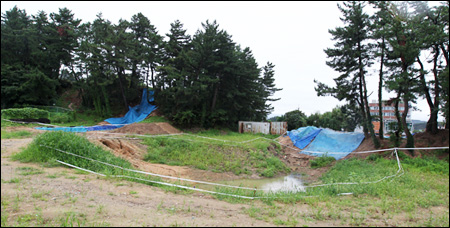
The discovery comes at a time when Japan is seeking to take the issue of Dokdo, Korea’s easternmost islets that it claims to the International Court of Justice (ICJ).
According to historic records, Gen. Isabu of the Silla Kingdom annexed the Usan Kingdom in 512 A.D. when he served as governor of Hasulla, the old name of Gangneung, during the Three Kingdoms Period.
There has been a lack of old materials which support that Gen. Isabu conquered the Usan.
The fortress discovered will support that the general left there to annex the kingdom 1,500 years ago, scholars said.
The fortress was found at a site where the construction of a hotel is underway.
Cha Jae-dong, who led the archeological team, said, “The circumference of the fortress is one kilometer. It is the largest Silla earthern fortress ever discovered on the Korean Peninsula. It is presumed to have been built in the late fifth or early sixth century.”
Korea plans to send a diplomatic document to Japan this week, dismissing Tokyo's proposal to take the Dokdo issue to the ICJ, foreign ministry officials said Sunday.
Korea has reaffirmed its stance that there should be no territorial disputes over the islets because they are clearly Korean territory.
President Lee Myung-bak made an unprecedented visit to the islets on Aug. 10, becoming the first Korean head of state to set foot on them. Korea has kept a small police detachment on Dokdo since 1954.
Kim Jong-un warns against S. Korea-U.S. military drill
Kim says, "There is a limit to our patience," adding he has "finally signed" an order of "battle to an all-out counter-offensive."
North Korea's leader once again warned of "the all-out battle" against the South, denouncing an ongoing joint military drill between South Korea and the United States, the North's state media said Sunday.
South Korean and U.S. forces began a 12-day annual joint military exercise, Ulchi Freedom Guardian, on Aug. 20 to test and improve their defense posture against North Korea, mobilizing some 56,000 South Korean troops and about 30,000 U.S. soldiers, according to military officials.
Seoul and Washington "are staging large-scale war drills for aggressions targeted against us," North Korean leader Kim Jong-un was quoted by the (North) Korean Central News Agency (KCNA) as saying during his speech at an Aug. 25 anniversary to celebrate what the communist country claims as former leader Kim Jong-il's start of "the military-first revolutionary leadership."
"There is a limit to our patience," Kim said, adding he had "finally signed" an order of "battle to an all-out counter-offensive."
The North Korean leader threatened on Aug. 18 to turn the west sea into "a graveyard of the invaders" during a visit to a front-line artillery unit near the tense western sea border that was responsible for the North's deadly bombardment of South Korea's Yeonpyeong island in 2010.
North Korea has long denounced the joint military exercises between the U.S. and South Korea, claiming they amount to a prelude to war. Seoul and Washington have countered that the drills are defensive in nature.
The young leader, during his visit to the frontline eastern sector, also watched a performance by the Moranbong Band with his wife Ri Sol-ju to celebrate the anniversary, according to the KCNA.
North Korea's leader once again warned of "the all-out battle" against the South, denouncing an ongoing joint military drill between South Korea and the United States, the North's state media said Sunday.
South Korean and U.S. forces began a 12-day annual joint military exercise, Ulchi Freedom Guardian, on Aug. 20 to test and improve their defense posture against North Korea, mobilizing some 56,000 South Korean troops and about 30,000 U.S. soldiers, according to military officials.
 |
Seoul and Washington "are staging large-scale war drills for aggressions targeted against us," North Korean leader Kim Jong-un was quoted by the (North) Korean Central News Agency (KCNA) as saying during his speech at an Aug. 25 anniversary to celebrate what the communist country claims as former leader Kim Jong-il's start of "the military-first revolutionary leadership."
"There is a limit to our patience," Kim said, adding he had "finally signed" an order of "battle to an all-out counter-offensive."
The North Korean leader threatened on Aug. 18 to turn the west sea into "a graveyard of the invaders" during a visit to a front-line artillery unit near the tense western sea border that was responsible for the North's deadly bombardment of South Korea's Yeonpyeong island in 2010.
North Korea has long denounced the joint military exercises between the U.S. and South Korea, claiming they amount to a prelude to war. Seoul and Washington have countered that the drills are defensive in nature.
The young leader, during his visit to the frontline eastern sector, also watched a performance by the Moranbong Band with his wife Ri Sol-ju to celebrate the anniversary, according to the KCNA.
2012-08-25
Dear Hashimoto, mayor of Osaka

This writing below is a letter to Hashimoto, mayor of Osaka, in response to Hashimoto's denial of comfort women being enforced into sexual slavery. This not only applies for Korea, but all the nations that suffered Japan's brutality and I hope this will notify the international community of the problems of comfort women. Let's not forget that without self-reflection of the past, there is no future.
I send this letter to Hashimoto, mayor of Osaka, a large city of 2.6 million people.
I read an article about your remarks on comfort women. You claimed that there is no evidence that comfort women were assaulted and threatened by the Japanese military to saceerve as sex slaves. You also noted that Korea must present proof that they were taken away by force. So I present to you the evidence to educate you to have a discerning eye.
First, somebody with common sense would not volunteer to become a comfort women in war. Or maybe you have somebody in your family that lacks this common sense, which led you to think that the comfort women volunteered under no duress.
Second, when Japan realized that nobody would volunteer for comfort women, Japan tried to trick the innocent women into sexual slavery by saying that the women would be find an employment opportunity at the war material factories. But when this failed, Japan coerced women into sexual slavery by assigning quota deliveries by regions.
Third, if you indeed recruited the women by volunteers, why are you trying to conceal the exact number of comfort women, and try to kill the comfort women to cover your filthy tracks when the war ended?
Fourth, there are testimonies from the women who suffered from sexual slavery, not only from Koreans, but from other countires, including even the Netherlands. What more proof do you need?
If you are ashamed of your crimes being revealed to the world, and deny your past, Japan's reputation will hit the bottom, no matter how powerful your economy is. You may claim to be an advanced country, but to the international community, your nations is a nation without conscience and human dignity.
2012-08-22
S. Korea to strengthen retaliation against N. Korea attack
South Korea will mount a much deeper and stronger counterstrike than any before in the event of North Korea launching an artillery attack, a senior military official said Tuesday, as Pyongyang toughens its rhetoric against ongoing annual military drills in the South.
South Korea and the United States on Monday began an annual military exercise that will run through Aug. 31, mobilizing some 56,000 South Korean troops and about 30,000 U.S. soldiers.
TheCombined Forces Command said it informed the North the UlchiFreedom Guardian exercise is “defensive in nature,” but Pyongyang decries it as “drills for a war” against the North.
During the largely computer-simulated exercise, the joint forces practice counterattack procedures that have been strengthened in the wake of the North‘s deadly artillery attack on a South Korean border island in 2010, the senior official said.
“The military will immediately strike the sources of attack, its supporting and commanding forces as well as corresponding targets in the event of an attack,” the official said, asking anonymity as he is not authorized to talk about military information. “It is an expression of our intention to devastate the source of attacks and its surroundings if the North provokes again, in a bid to prevent it from launching an additional attack.”
South Korea has strengthened its rules of engagement after two deadly attacks by the North in 2010, and now calls for an immediate strike against “the sources of attack as well as its supporting forces” if attacked.
North Korea has increased its hostile rhetoric, with leader Kim Jong-un visiting and lauding an army unit responsible for the 2010 artillery strike. Kim told the soldiers to prepare for “sacred war” should “even a single shell” hit the country’s territory, according to state media.
The Koreas remain technically at war after the 1950-53 Korean War ended in an armistice. About 28,500 U.S. soldiers are stationed here to deter against the North Korean threat.
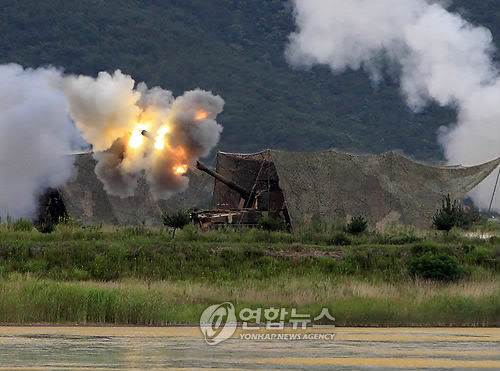
 K-9 self-propelled artillery firing shells in a military practice
South Korea and the United States on Monday began an annual military exercise that will run through Aug. 31, mobilizing some 56,000 South Korean troops and about 30,000 U.S. soldiers.
TheCombined Forces Command said it informed the North the UlchiFreedom Guardian exercise is “defensive in nature,” but Pyongyang decries it as “drills for a war” against the North.
During the largely computer-simulated exercise, the joint forces practice counterattack procedures that have been strengthened in the wake of the North‘s deadly artillery attack on a South Korean border island in 2010, the senior official said.
“The military will immediately strike the sources of attack, its supporting and commanding forces as well as corresponding targets in the event of an attack,” the official said, asking anonymity as he is not authorized to talk about military information. “It is an expression of our intention to devastate the source of attacks and its surroundings if the North provokes again, in a bid to prevent it from launching an additional attack.”
South Korea has strengthened its rules of engagement after two deadly attacks by the North in 2010, and now calls for an immediate strike against “the sources of attack as well as its supporting forces” if attacked.
North Korea has increased its hostile rhetoric, with leader Kim Jong-un visiting and lauding an army unit responsible for the 2010 artillery strike. Kim told the soldiers to prepare for “sacred war” should “even a single shell” hit the country’s territory, according to state media.
The Koreas remain technically at war after the 1950-53 Korean War ended in an armistice. About 28,500 U.S. soldiers are stationed here to deter against the North Korean threat.
Diplomat asks Japan to bet Tsushima on its bid for Dokdo
Japan should bet Tsushima on its bid for Dokdo, a senior Korean diplomat said Monday. The island of Tsushima is the closest Japanese territory to the Korean Peninsula, lying approximately 50km from Busan. Dokdo is a group of small islets in the East Sea.
“If Japan lodges a protest with Korea over Dokdo, it should bet Tsushima,” the diplomat, Chang Dong-hee, said in a radio program.
He made the remarks after news reports that Tokyo will take the issue of Dokdo, Korea’s easternmost islets claimed by Tokyo as its territory, to the International Court of Justice (ICJ).
When asked about Japan’s alleged move to take Dokdo to the international court, Chang said doing so unilaterally makes no sense.
He said the ICJ can exercise jurisdiction only when the two countries concerned agree on it; a pact struck between the two nations stipulates that if any similar disputes occur, they will take them to the international court; and both parties accept the ICJ’s compulsory jurisdiction.
He said since Korea will not agree to the ICJ’s jurisdiction, filing a complaint unilaterally will not make any sense.
As to concerns that if conflicts occur in waters near Dokdo, they will be referred to the ICJ, Chang said even if the U.N. Security Council asks for taking the case to the international court, jurisdiction could be exercised as long as Korea opposes it.
Japan should bet Tsushima on its bid for Dokdo, a senior Korean diplomat said Monday. The island of Tsushima is the closest Japanese territory to the Korean Peninsula, lying approximately 50km from Busan. Dokdo is a group of small islets in the East Sea.
“If Japan lodges a protest with Korea over Dokdo, it should bet Tsushima,” the diplomat, Chang Dong-hee, said in a radio program.
He made the remarks after news reports that Tokyo will take the issue of Dokdo, Korea’s easternmost islets claimed by Tokyo as its territory, to the International Court of Justice (ICJ).
When asked about Japan’s alleged move to take Dokdo to the international court, Chang said doing so unilaterally makes no sense.
He said the ICJ can exercise jurisdiction only when the two countries concerned agree on it; a pact struck between the two nations stipulates that if any similar disputes occur, they will take them to the international court; and both parties accept the ICJ’s compulsory jurisdiction.
He said since Korea will not agree to the ICJ’s jurisdiction, filing a complaint unilaterally will not make any sense.
As to concerns that if conflicts occur in waters near Dokdo, they will be referred to the ICJ, Chang said even if the U.N. Security Council asks for taking the case to the international court, jurisdiction could be exercised as long as Korea opposes it.

“If Japan lodges a protest with Korea over Dokdo, it should bet Tsushima,” the diplomat, Chang Dong-hee, said in a radio program.
He made the remarks after news reports that Tokyo will take the issue of Dokdo, Korea’s easternmost islets claimed by Tokyo as its territory, to the International Court of Justice (ICJ).
When asked about Japan’s alleged move to take Dokdo to the international court, Chang said doing so unilaterally makes no sense.
He said the ICJ can exercise jurisdiction only when the two countries concerned agree on it; a pact struck between the two nations stipulates that if any similar disputes occur, they will take them to the international court; and both parties accept the ICJ’s compulsory jurisdiction.
He said since Korea will not agree to the ICJ’s jurisdiction, filing a complaint unilaterally will not make any sense.
As to concerns that if conflicts occur in waters near Dokdo, they will be referred to the ICJ, Chang said even if the U.N. Security Council asks for taking the case to the international court, jurisdiction could be exercised as long as Korea opposes it.
Japan should bet Tsushima on its bid for Dokdo, a senior Korean diplomat said Monday. The island of Tsushima is the closest Japanese territory to the Korean Peninsula, lying approximately 50km from Busan. Dokdo is a group of small islets in the East Sea.
“If Japan lodges a protest with Korea over Dokdo, it should bet Tsushima,” the diplomat, Chang Dong-hee, said in a radio program.
He made the remarks after news reports that Tokyo will take the issue of Dokdo, Korea’s easternmost islets claimed by Tokyo as its territory, to the International Court of Justice (ICJ).
When asked about Japan’s alleged move to take Dokdo to the international court, Chang said doing so unilaterally makes no sense.
He said the ICJ can exercise jurisdiction only when the two countries concerned agree on it; a pact struck between the two nations stipulates that if any similar disputes occur, they will take them to the international court; and both parties accept the ICJ’s compulsory jurisdiction.
He said since Korea will not agree to the ICJ’s jurisdiction, filing a complaint unilaterally will not make any sense.
As to concerns that if conflicts occur in waters near Dokdo, they will be referred to the ICJ, Chang said even if the U.N. Security Council asks for taking the case to the international court, jurisdiction could be exercised as long as Korea opposes it.

2012-08-21
Gov't Expresses Regret over Japan's Proposal on Dokdo Issue

Foreign Ministry spokesman Cho Tae-young told a regular news briefing on Tuesday that the Dokdo islets are South Korea’s sovereign territory historically, geographically and under international laws, stressing a territorial dispute over Dokdo doesn't exist.
The spokesman also dismissed Japan’s proposal that Seoul and Tokyo enter into an arbitration process in line with a memorandum on conflict resolution the two sides signed in 1965.
Tokyo sent an official diplomatic letter Tuesday evening to propose a referral of the Dokdo issue to the international court. Seoul plans to respond to Tokyo in a diplomatic letter refuting Japan’s claim and clarifying its position on the proposal.
2012-08-20
Kim visits sea border before joint South drill

The unit Kim visited was responsible for shelling South Korea’s Yeonpyeong Island in November 2010, killing four South Koreans.
Kim’s appearance at the unit on Mudo, or Mu islet, came two days before the planned launch of Ulchi Freedom Guardian, annual joint exercises by South Korea and the United States. The exercises are set to start today and continue until Aug. 31 and they involve some 56,000 South Korean troops and 30,000 U.S. soldiers.
“If the enemy dares to recklessly pre-empt firing and even a single shell drops on the territory of the Democratic People’s Republic of Korea [North Korea’s official moniker], the Korean People’s Army [KPA] should lead the battle to a sacred war for national reunification, not confining it to a local war on the southwest region,” the young leader was quoted as saying by the North’s Korean Central News Agency (KCNA). “He also ordered it to turn the west sea into a graveyard of the invaders,” the KCNA said.
According to footage from Pyongyang’s Korean Central Television and KCNA, Kim reached the western sea border on an unarmed, small wooden boat accompanied by a dozen officials including Choe Ryong-hae, director of the KPA’s General Political Bureau, and Kim Yong-chol, director of the Reconnaissance General Bureau. Hyon Yong-chol, who was promoted to vice marshal last month, was not shown in the footage. Earlier in the day, Kim also inspected a defense detachment on the nearby island of Jangjae.
Analysts in Seoul said Kim’s decision to reach the unit in a small, wooden boat could have made for both political and security purposes. Kim may have been attempting to show his courage to his own military and the public while at the same time avoiding South Korea’s radar surveillance, analysts said.
According to its English-language dispatch, the leader also “ordered the service persons of the detachment to be vigilant against every move of the enemy.” Kim gave service members pairs of binoculars, automatic rifles and machine guns as gifts.
“The purpose of Kim’s visit could be aimed at tightening his grip over the military by demonstrating courage as a leader by visiting the dangerous far frontline,” said Chang Yong-seok, a senior researcher at the Seoul National University’s Institute for Peace and Unification Studies.
2012-08-19


2012-08-14

2012-08-08
Subscribe to:
Posts (Atom)

